

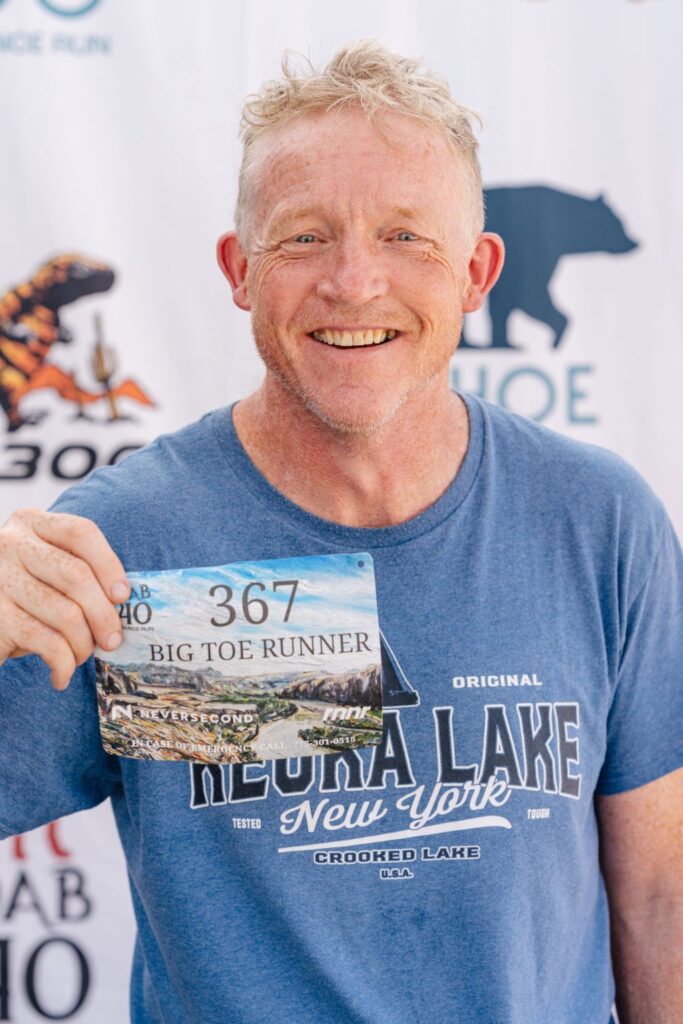
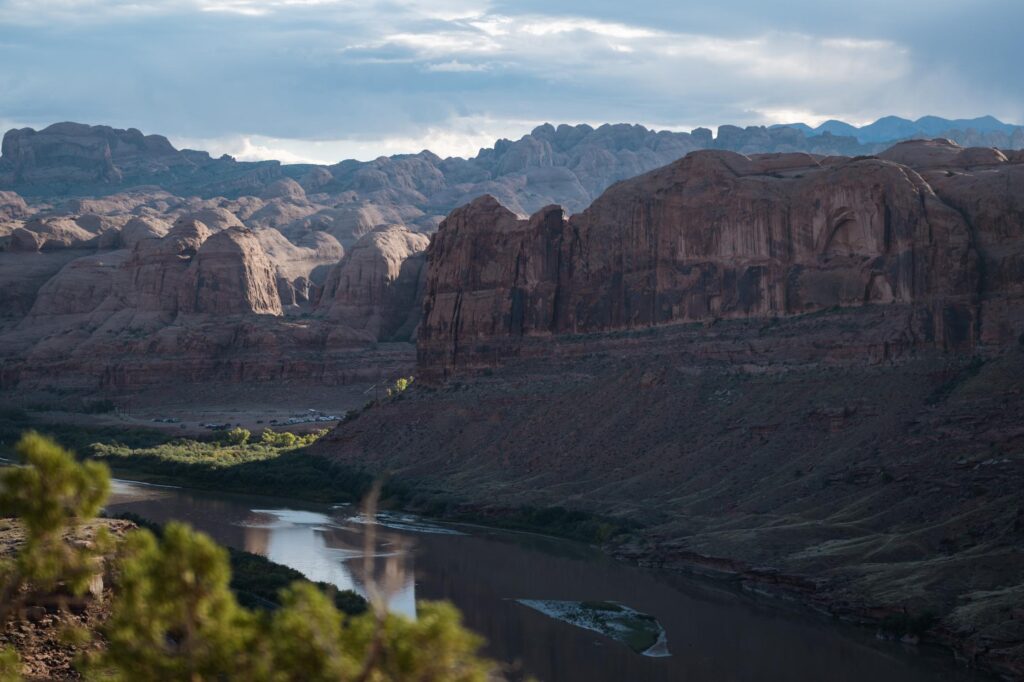
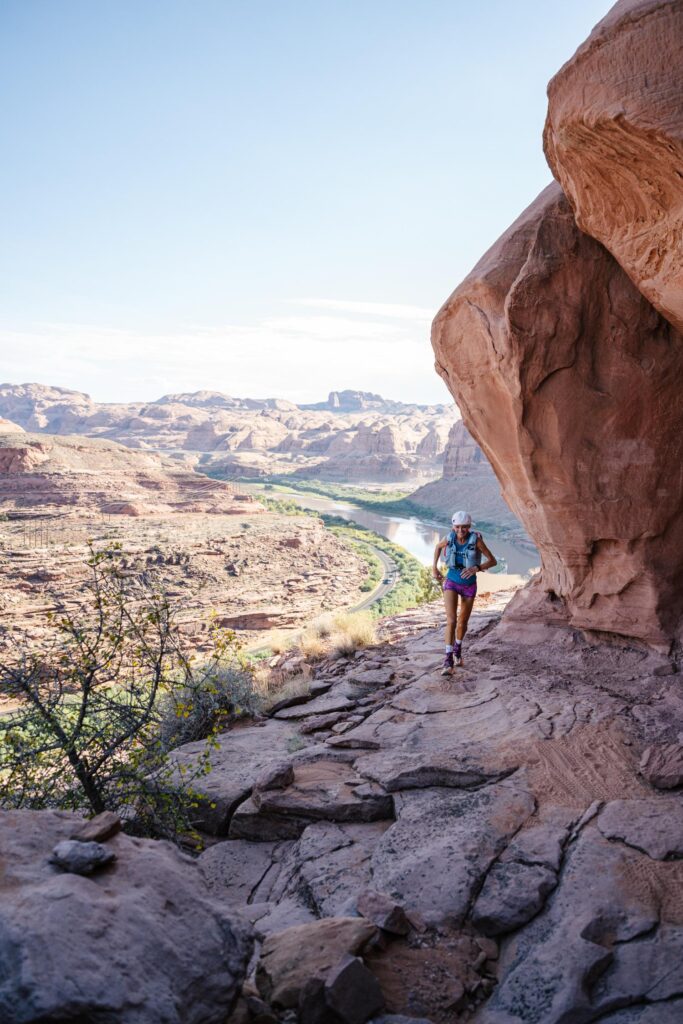
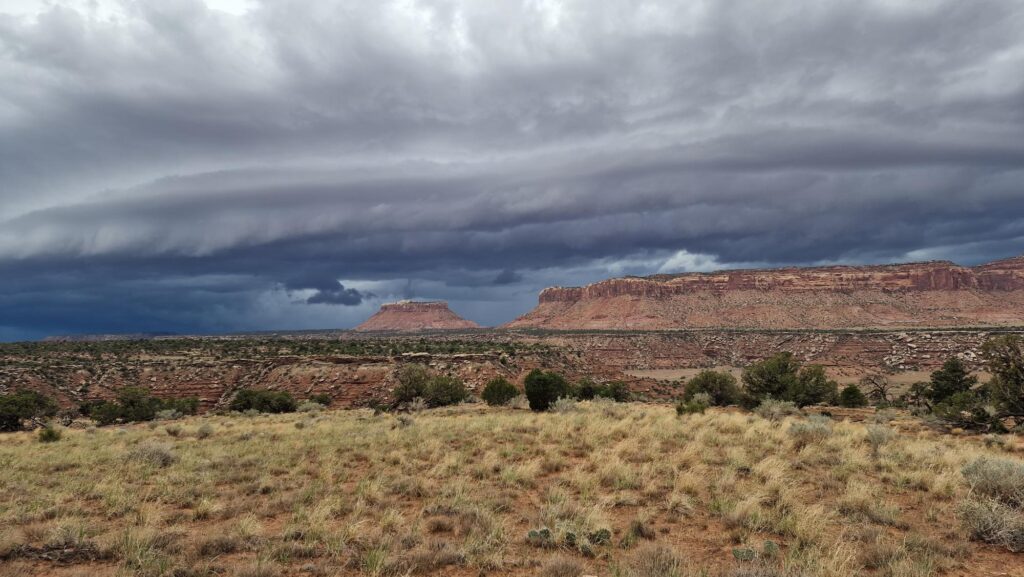
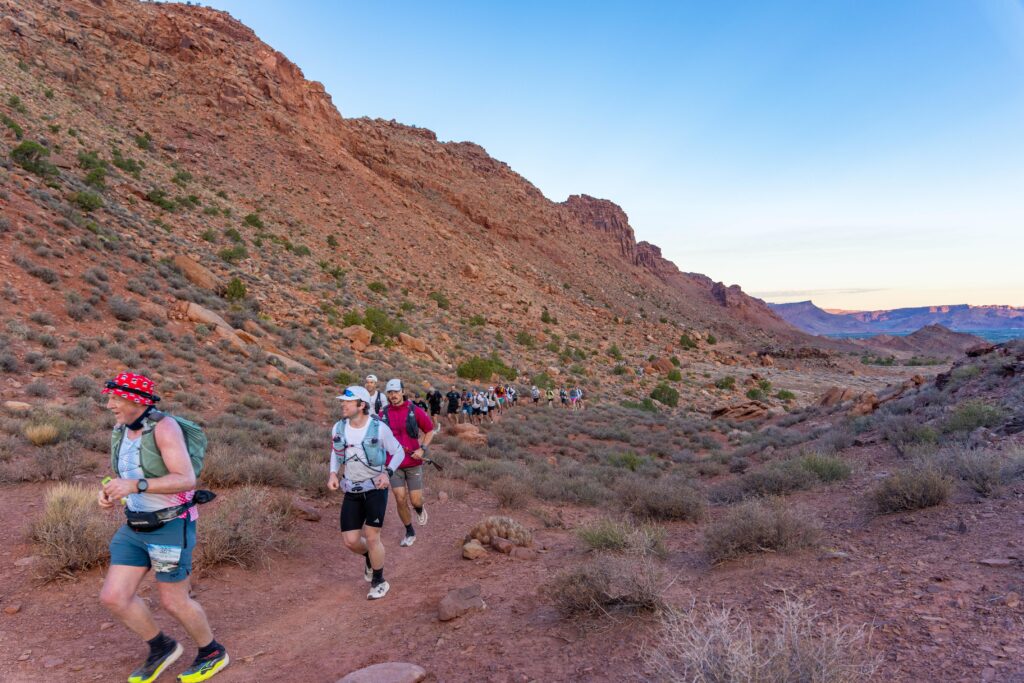
(Photos top to bottom: 1 and 6 Chris Gerber(@chrisgerber.photos, 2, 3, 5, Anastasia Wilde. 4 Frank Wainwright taken during his race)
Moab 240 is a complex footrace, especially if you go it alone, using dropbags but no pacers or crew. You don’t have to be experienced to take this race on, but you don’t want to be naïve either. It’s a beast. First, it will bake you in desert canyons before freezing you to a hyperthermic ready meal of a runner.
I considered myself ‘ready’ for it after taking 80 hours for the 260 miles of Lon Las Cymru in October 2025, the length of Wales from Holyhead to Cardiff, a brutal self-navigating race where crews are not allowed and dropbags are only every 50 miles. With cut off at 89 hours Lon Las has a tiny completion rate. I’d have 113 hrs for Moab.
I’m 56 now and want to round off my ultrarunning CV. I’ve run 100 miles across a frozen lake at minus 30C, but figured I need to try survive in heat. Moab is hot. As I would discover, it’s an absolute oven.
Heat is not my habitat, but I love the whole idea of deserts and canyons. I’m not tempted by Marathon Des Sables, as I see many people who could not complete the ultras I have, completing it. I’m not tempted by Death Valley’s Badwater 130 as a crew is essential and it’s a road run. But Moab, with its roasting canyons for 100 miles followed by high peaks and likely snow in the next 100, before descending into the desert again, is the complete package for getting a sunstruck+altitude adventure on the CV. It first hit my radar when reading about Courtney Dewaulter’s magnificent achievements, winning the inaugural race outright. Forget the oft-cited icon on Moab 240, David Goggins – too in your face macho for my tastes – following Coutney’s happy steps drew me in. And I really liked the look of Candice Burt’s set up with Destination Trail, a business that speaks from its heart.
Getting to the startline was a massive training chore, hours of hills, walking and running. My mileage peaked about 6 weeks out at 125 in one week, and then I cunningly combined a business trip to Cyprus with midday cliff running and hiking to acclimatise in the week or so before I flew to Utah. I bridged the gap of a few days back in chilly Wiltshire with trips to local sauna Drift and Embers. I timed my runs to end sweatily at their door.
A further challenge, my feet had been weak with metatarsalgia since 188 miles of Sea-to-Sea ultra in March, a run across England via my namesake’s Wainwright’s Way that replaced the cancelled Northern Traverse. Ahead of Moab, I managed my feet well – training in Brooks Caldera and toe socks gave me the cushioning and splay that I needed to rehab them without compromising my mileage.
Before flying out, I tried to plan 10 drop bags that allowed for the changing conditions along the route. A Rabbit ice bandana went in drop bag number one. I also Shoo Goo’ed Velcro to the Calderas, my startline shoes and a pair of New Balance Hiero, 4E Extra Wide to change into at 140 miles when I estimated that my feet would be bursting out of the Calderas. The Velcro is for fitting Altra’s excellent gaiters, a footcare essential in sandy, dusty and stony terrain.
A core requirement of Moab, especially for the foolhardy self-supported runners, is drop bag prep. In the early stages I would need to be able to carry 4 litres of water. In the mountains warm layers and waterproofs take up the space vacated by the extra litres. Everything needs to be partitioned and waterproofed – spare headtorches, waterproof gloves, powerbanks. Packing up at home I soon found that I had no space for leisurewear in my suitcase, everything was Moab. Even so I left stuff behind. I could have done with a 3rd pair of trainers as my Caldera’s cushioning surrendered at 80 miles. One thing I did get right was a sleeping bag for Bridger Jack, the 96-mile mark…
So, packed and ‘planned’, I flew to Salt Lake and took s few days to acclimatise, visiting roaming bison at Antelope Island and then some astonishing geology at Bryce Canyon and Dead Horse Point. It was great hiking about to get some sun on my back and shaking off the -7 hrs jet lag.
At the race briefing we were forewarned that conditions would be challenging with the sun coming on strong for the canyons and rumours of a mountain storm reaching our route’s high mountain passes, the wandering periphery of Tropical Storm Rachel as it spiralled inland from Baja California. “You’ll be pleased to get back to the heat” said RD Garret Froelich at an assembly that was just a bit short on chairs and shelter… a theme that would later repeat at the aid stations.
Moab is an increasingly popular adventure, a lottery helping to fill most of the 400+ places. The event has nearly doubled in two years… when you add in crews, supporters and pacers. it becomes quite a gathering.
The night before I did manage some crucial shut eye in a wooden cabin 3 mins walk away. Proximity paid off. I slept as well as might be expected using a single beer as a sleeping draft – my compromise vs. restlessness. I reached the 6am startline in the best shape I had been in all year.
***
We collected out trackers in the dark. Then we collectively made the event’s macho oath to blame only ourselves if we die, and trotted off up the road to the awaiting oven, high spirited turkeys looking for a baking tray. Three of us formed a little pod of English, Archie Dawe and Leah Williams whose accents identified them through the dark. There was also an American, Maddie Brady, who I would overlap with many miles later.
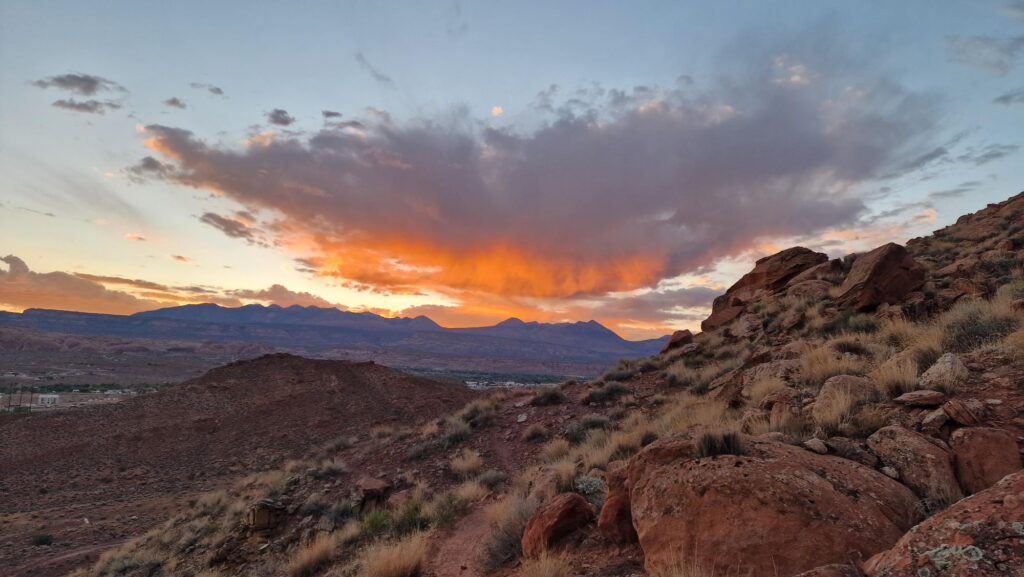
(photo Frank Wainwright, mid race pic)
The sun came up over Hidden Valley and then bam, we lipped over a crest and into the desert properly, the orange dust, a backdrop of the crags and cliffs and a path marked across the sandstone slickrock. I was thrilled. There’s something so monumental about these naked pyramidal hills virtually denuded of fauna, with thirsty lizards peeking out of the few hardy succulents including fishhook cacti. These became a menace underfoot when the weather later changed.
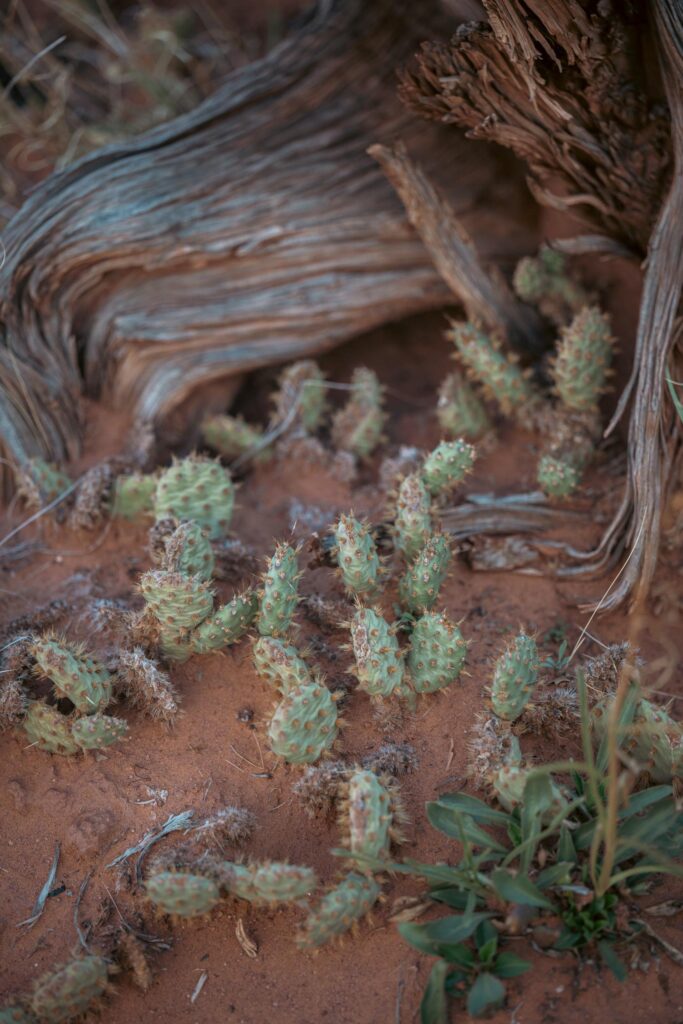
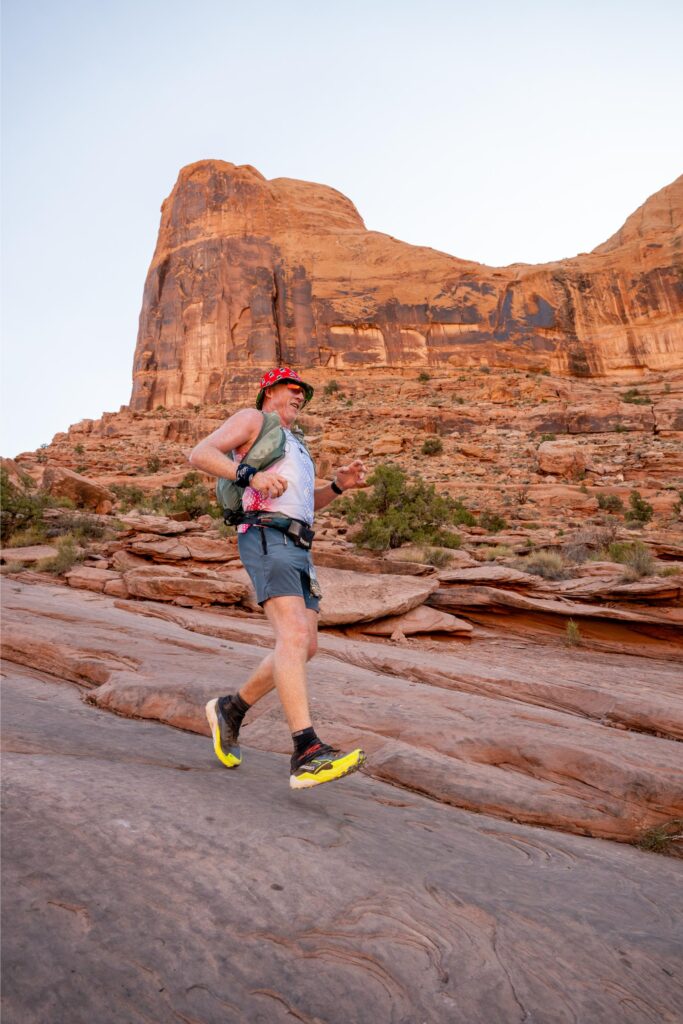
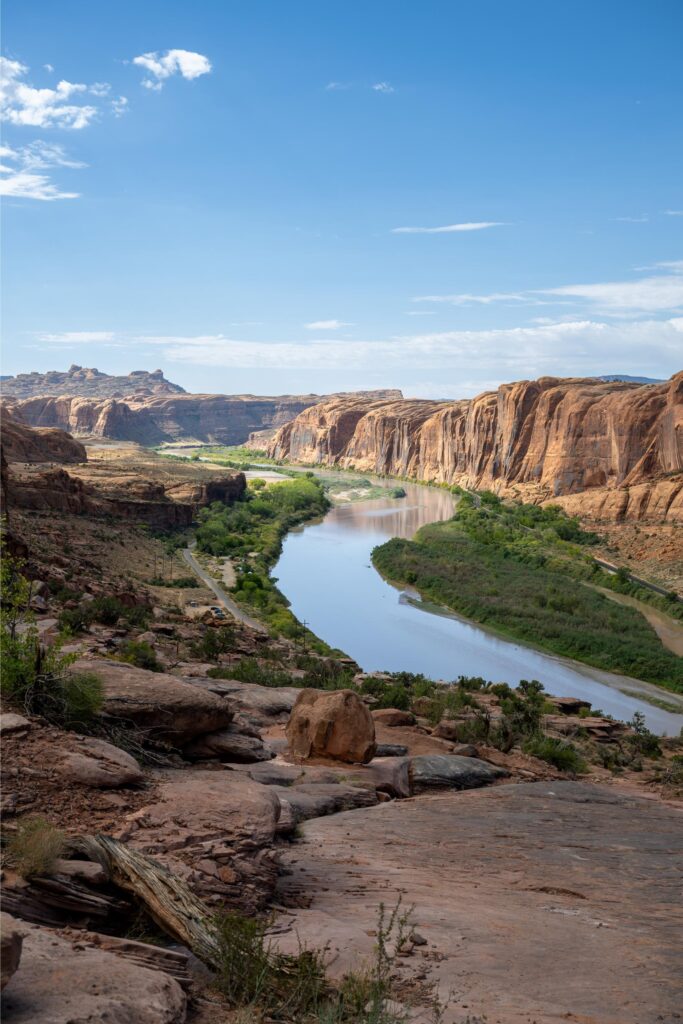
(Photos above: 1, Jon Siu (@guesssiu 2 & 3 Esther Ramos(@estherramosphoto))
The section to Amasa Back was bewilderingly beautiful and challenging with some exacting terrain and the Colorado River for company. We had thinned out to clusters now, passing an area that has seen campgrounds closed for a controversial development in the remote back country.
The Amasa Back aid station (17-mile mark) arrived awash with hundreds of crew who had to take a shuttle on rota to get there. The luxury of Coke was already on the wane as I passed, at a guess about 2/3 through the field. But thankfully there was ice to cool off the warm water that went into my wide-necked bottles. I filled 3 litres as well as my ice bandanna. The heat had cranked up alarmingly quickly. Without fully realising it we were frying, the land hugging the heat, as we headed out on the section to Base Camp Aid Station (29-mile mark). It’s a very deceptive section, narrow trails and scrambles, the sun-exposed climbs soon leaving the river to sparkle like a snake deep in the ravine.
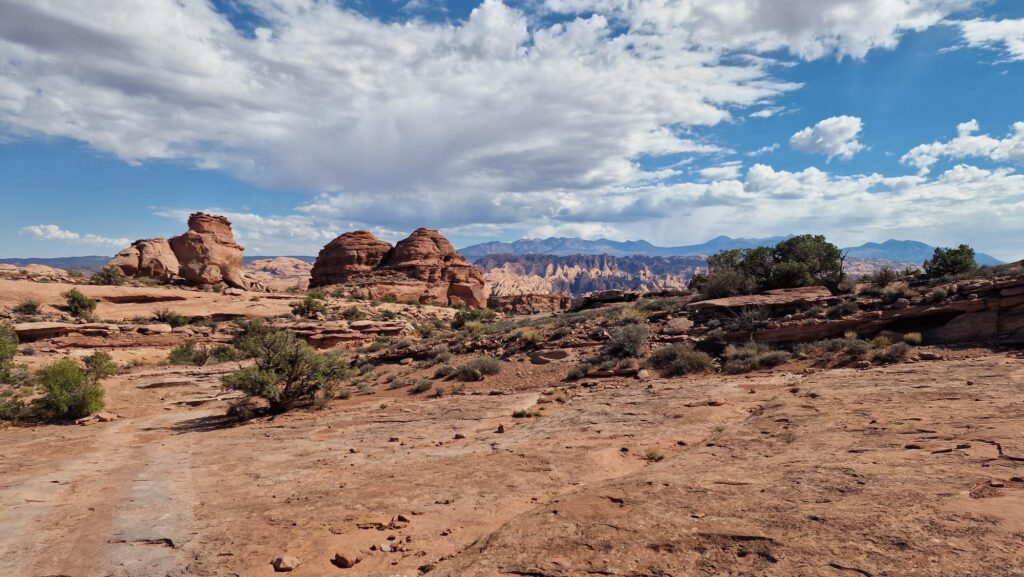
(photo Frank Wainwright, taken during the event)
Weighed down with water my pack started to cut into my shoulders as the minimal vest I had chosen for lightness couldn’t protect them. Once the ice had melted, I used my bandanna as padding. I was carrying a list of what supplies I had at each dropbag. There were buffs packed for Base Camp I could use as padding, but I really wanted a capped t-shirt to protect my shoulders properly. That would have to wait until mile 50 and my Oasis dropbag. Until then, damage limitation.
Soon I wasn’t thinking about that pain as we arrived at a heady cliff edge and the twisting descent into the canyon floor, Jackson’s Ladder, with a descent grade maxing out at 60%.
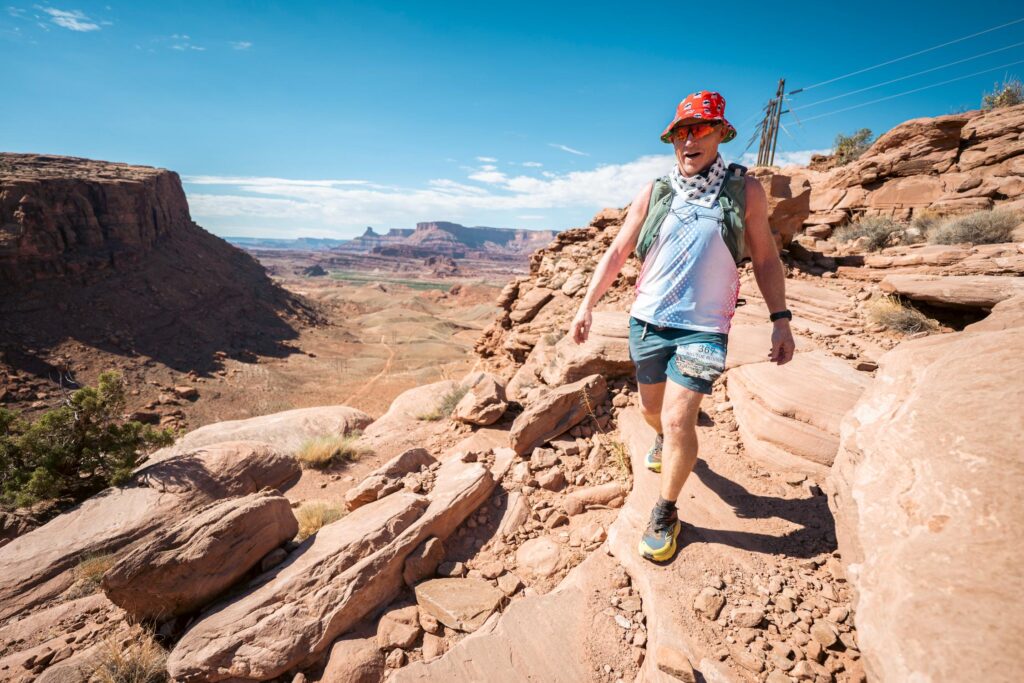
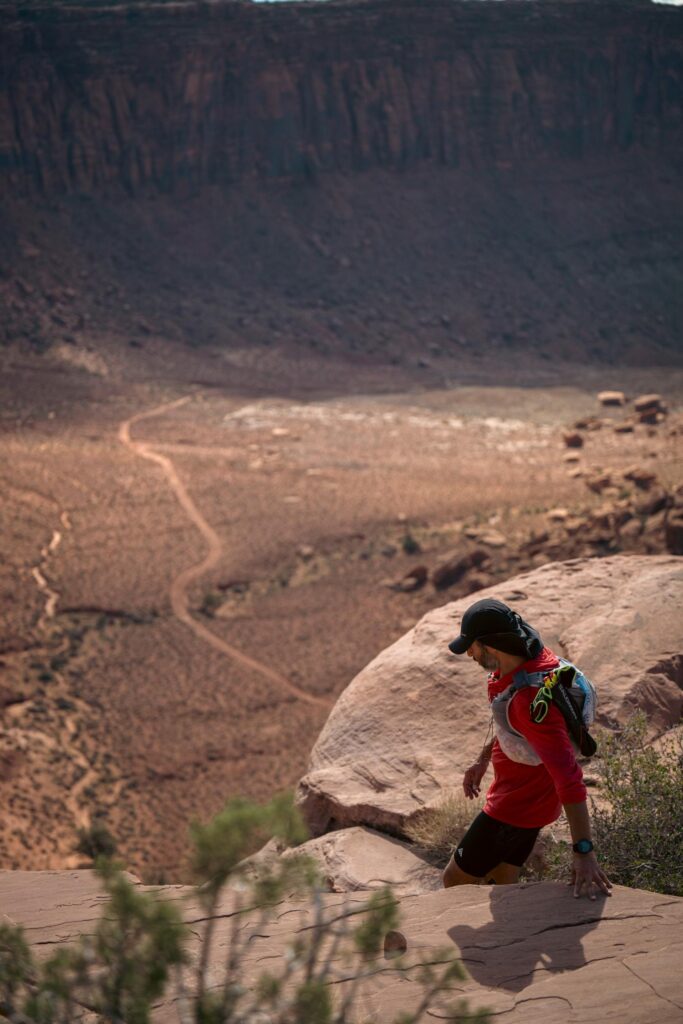
(2 photos above – Jon Siu (@guesssiu))
You are so exposed on that descent that some staggered once down the basin, sunstruck to illness, their Moab done and out. Base Camp is ‘only’ 29 miles yet it still claims 10-15 DNFs. When I got there the water was warm, ice and soda was out, being reordered, and even warm water was running low. I filled up. 3 litres is the mininmum allowed by the race rules and I took 4, topping them up again at Lockhart basin, a water only station 5 miles further on. From Lockhart the extreme remoteness means there are 20 miles to cover before Oasis. I got there in darkness, strengthening as the sun went down and took a personal bow. I’d run 50 miles in desert heat, knowing I could get stronger through the night. I was a bit behind schedule but heat like that is my nemesis. And at last I had a t-shirt to stop my bleeding shoulders from worsening.
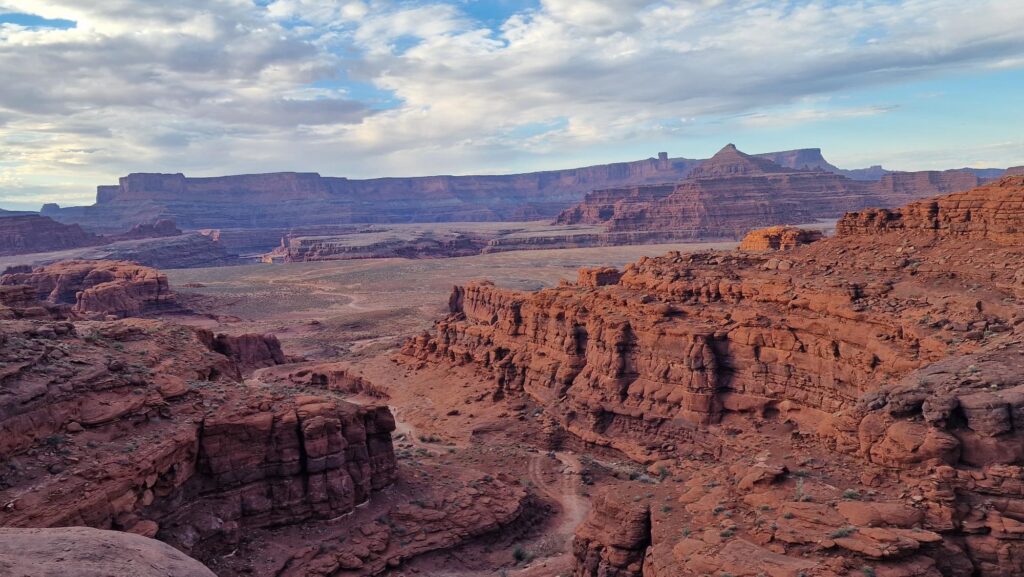
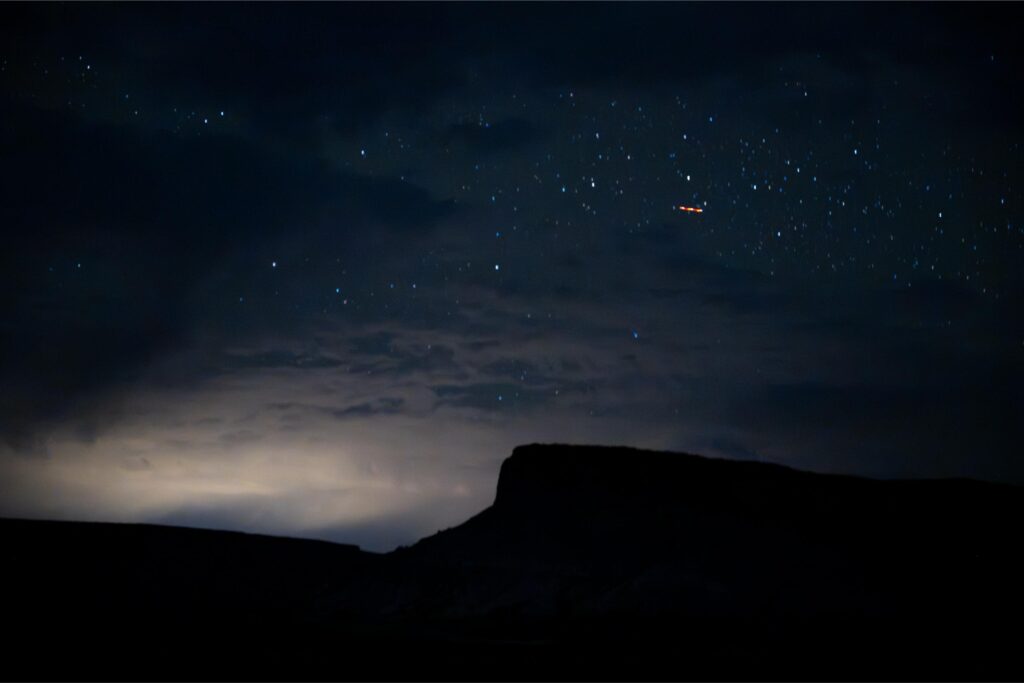
(Photos – Frank Wainwright, taken during the race and Esther Ramos(@estherramosphoto))
From here the route barely hints at any downhill for 50 miles. It’s all up. Sudden weariness in the small hours – a bit of residual jet lag maybe? – meant a dirt nap was necessary and I passed out comfortably under the stars for half an hour. The night was giving way to day as I made Indian Creek aid station, 69 miles at around 6am. It would be a furnace there under the black canvas tents by 8am so I aimed for an hour’s sleep, getting 45 mins. 24hrs to complete 69 miles is a personal worst of sorts, but I was OK with that, planning for long distances ahead. I was fuelled and felt fairly rested. I picked it up a bit, leaving that excellent aid station full of burger and grapefruit Fresca soda.
Just up ahead was Maddie, last seen at the startline and now with her pacer. I remembered my strategy to of use other people’s pacers to drive myself on and keeping their chipper stride in distant view kept my forwards focus.
Getting from Indian Creek to 100 miles at Bridger Jack was relatively straightforward. Changing layers and moving swiftly in the cool wind and swirling rain was my comfort zone. Finally, I was bumbling along, climbing and climbing, hood up and happy. The storm coming in was outrageous to look at, shocking, but I felt fine. I’d dropped the right kit into the right bags and was clamboring up the relentless side of Bridger Jack with one solid plan. Arrive at 9pm, sleep/rest two hours, leave at 11 an hour ahead of the cut.. The wide trail hike up Shay Mountain to follow would suit me and I thought I would pick up time vs the cut. But first, focus on Bridger. I was hallucinating mildly, saw a train at one point. I needed sleep.
At Bridger my heart sank. Runners had stayed to ride out the storm. Every cot was taken. I was offered a sun bed by the fire, a daft solution as it was clearly going to pour.
I should have pressed on, but a cot was found. 20 minutes after I lay down the climbers on Shay Mountain turned back by an impassable flash flood, came back to Bridger sopping wet and freezing cold. Our part of the race was called as cancelled. and we were ordered to stay put to past the midnight cutoff. Three drenched bedfellows came to join me on my narrow cot. Somehow we passed the night, the basic canvas cracking like a whip. The woman next to me was asleep, her feet still out there somewhere on the mountain, running against my chest.
A man even lodged into the dirt floor beneath my cot, using our bodies as heat and shelter.
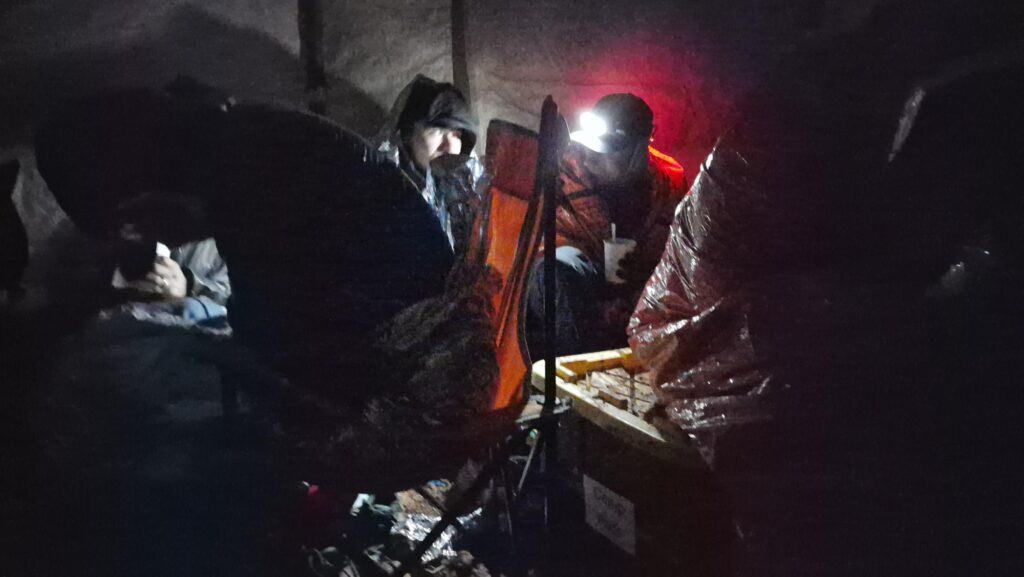
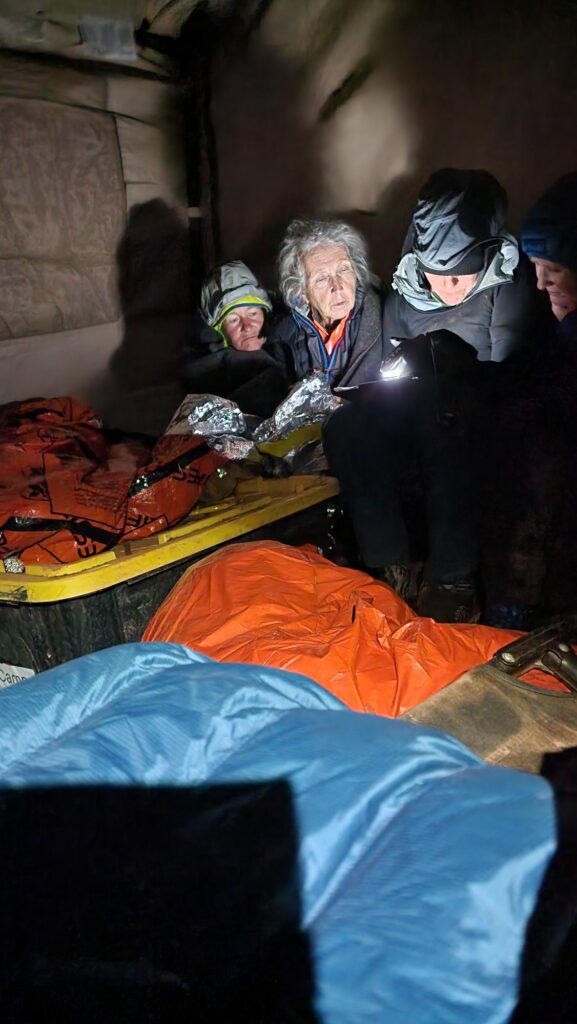
(Photos – Frank Wainwright)
I was in my very sensible sarcophagus sleeping bag, packed into my drop bag. There was jealousy as people thought I’d been given a special favour!
It rained and galed all night.
The Bridger Team, now host to 130 runners, pacers and crew rescued from an abandoned car, made burgers and cup noodles all night, and heated up apple juice.
We were out of the race. Those that had turned back had clearly been frightened to cross the flash flooded creeks and canyons on their way up to a 3000m mountain summit. It was very understandable. In 2015 a storm killed 20 hikers as flash floods hit canyons in and around Utah’s Zion National Park. The organisers made the right call. Events like this hold collective responsibility.
In the morning our silver foil army used a window in the weather to hike out. We thought it would be 15 miles but a squad of the sheriff’s most daredevil drivers had other ideas and drove up to meet us. Young sheriff Callaghan was my group of 12’s saviour. We clung to the open-air truck sides as he roller-coasted out through the mud road, slewing past the lethal drops. We were all covered in orange mud, stained to the same skin profile of the American president. We finally pulled up next to the helicopters that they were using to spot people stranded in remote places. Next to the helicopters, a rank of classic style US school busses awaited to take us back to town.
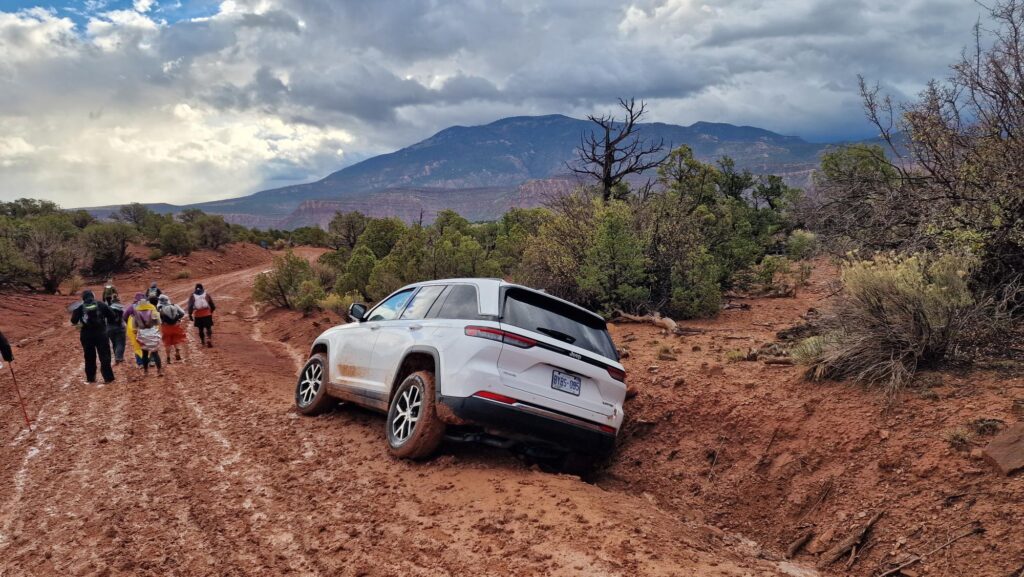
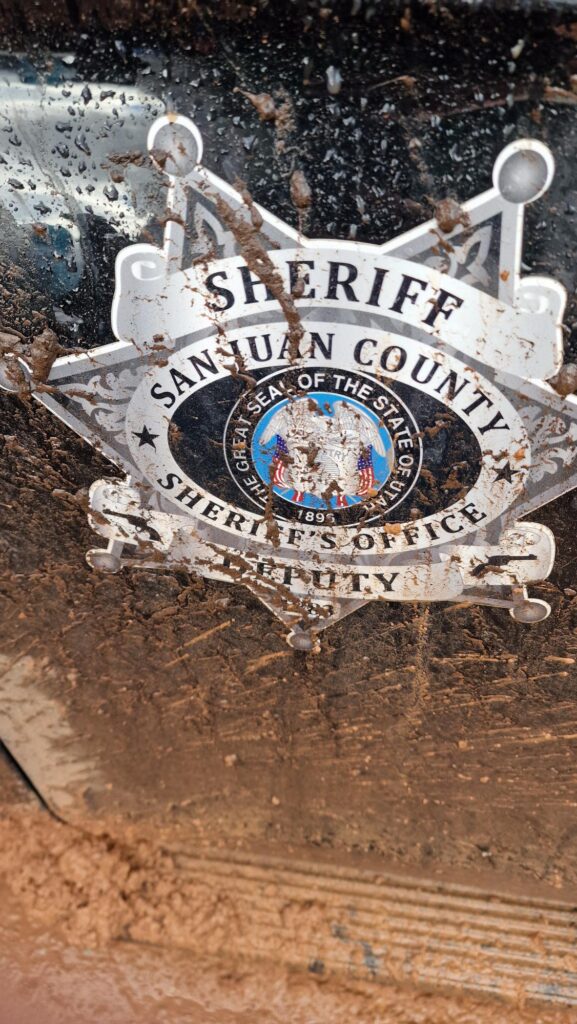
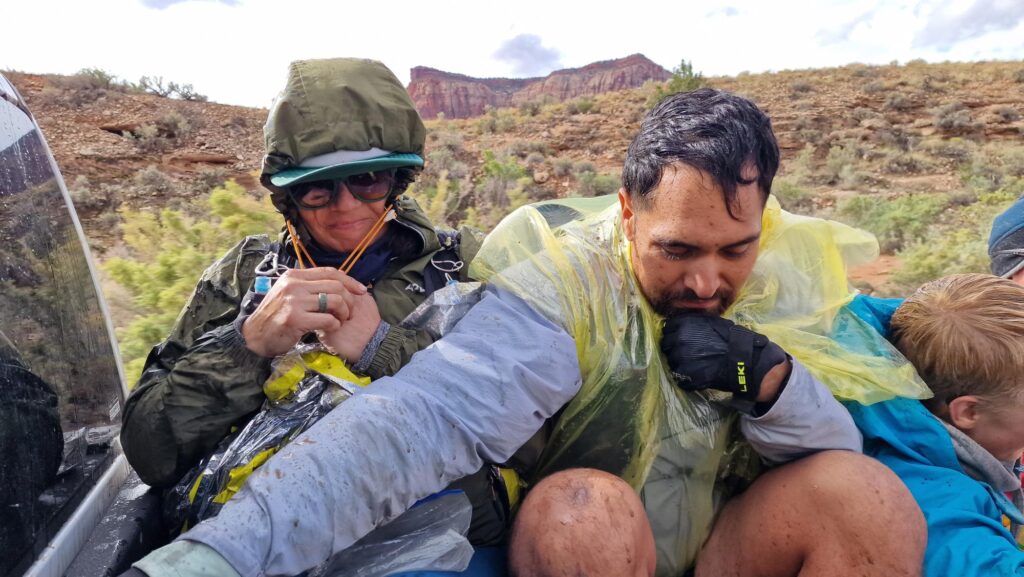
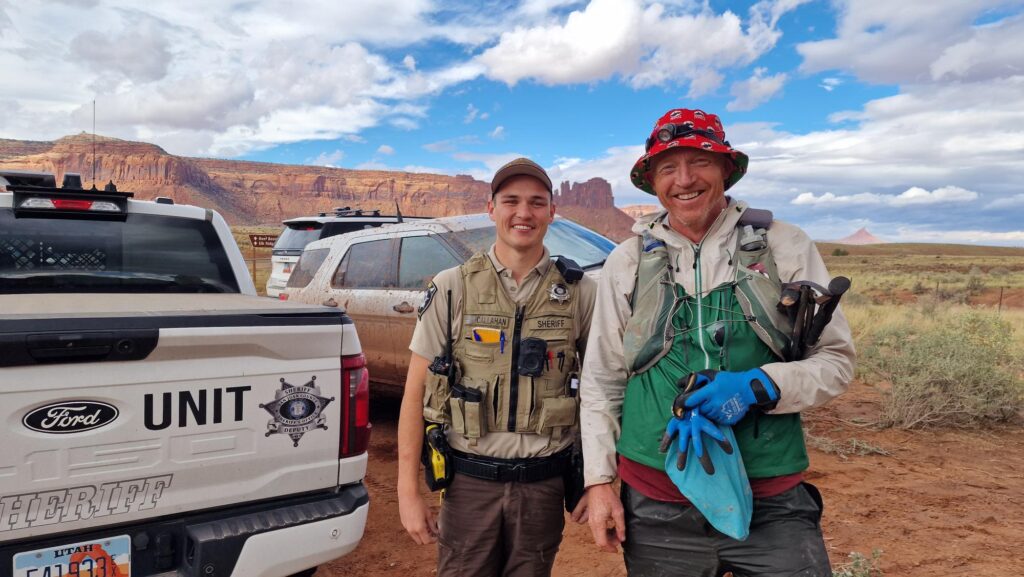
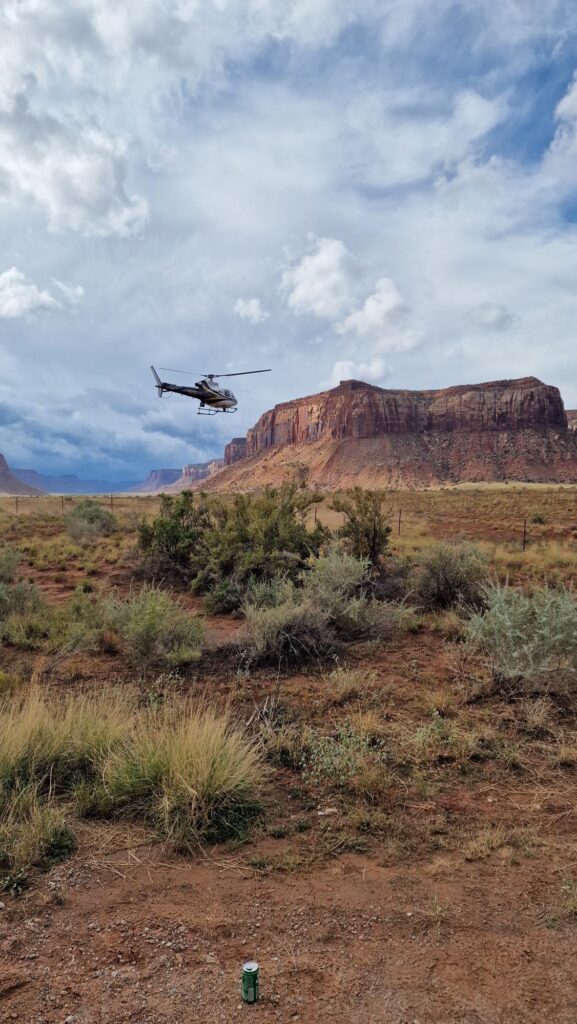
(Photos – Frank Wainwright)
This wasn’t the finish line we wanted, but it was a finish line that felt oddly elevating. Sadly, for the event. that storm didn’t go very far, moving from the La Sal mountains where we had been, to the Abajo peaks that the leaders reached 24 hours later. There it whacked the trees down with such abandon that everyone understood the total event cancellation.
Will I go again? Destination Trail have a guaranteed place on hold with a 25% discount. I’d love to take on that terrain again. I have conquered that desert for 100 miles and the organisers are sending me a unique buckle to commemorate ‘the Moab 96’. I’ve given them the feedback about cot spaces at Bridger Jack. If they can address this I’ll be mighty tempted. Many of the people I met on the trail are going to go back so there’s a reunion of sorts in prospect. I really want that feeling that you must get at Porcupine Rim, of stumbling down off the mountain and back into the canyons for Moab’s frazzling finale.
My result? 132 people made the Shay Mountain aid station after Bridger Jack or further. 223 runners were still active when their part of the race was cancelled. I think 355 started. So, I’m =133rd out of 355.
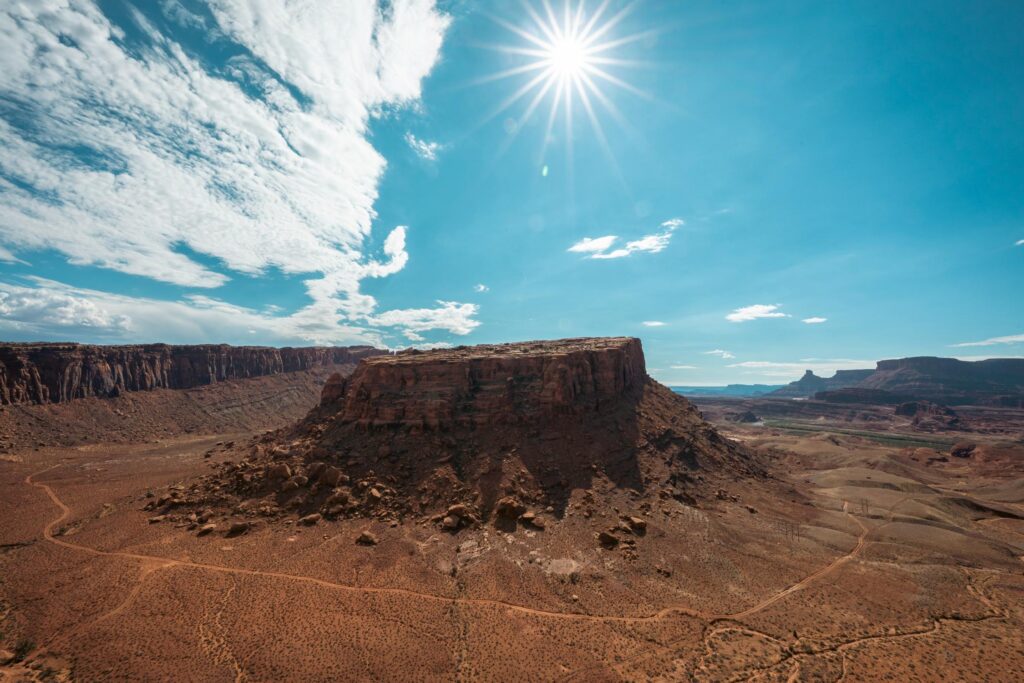
(photo Jon Siu (@guesssiu)


